
- Content Distribution Strategy in 2026: How to Turn Published Content Into Traffic and Leads
- Publishing content is not the same as marketing it
- Why valuable articles often receive little traffic
- Start with technical discoverability
- Build distribution around the customer journey
- Use an owned, earned, shared, and paid framework
- Create a distribution package for every major article
- Adapt the message instead of copying it everywhere
- Treat internal linking as a distribution channel
- Make email a central part of distribution
- Earn distribution through original value
- Use paid promotion selectively
- Prepare content for AI-supported discovery
- Build a realistic distribution timeline
- Measure the entire distribution funnel
- Common content distribution mistakes
- A practical 90-day content distribution plan
- Make distribution part of content creation
Content Distribution Strategy in 2026: How to Turn Published Content Into Traffic and Leads
Before investing time or money in content promotion, confirm that the published page can actually appear in Google. A practical step-by-step guide is available at https://infok.com.ua/blog/yak-pereviryty-chy-storinka-ye-v-indeksi-google.html. This initial check helps distinguish an indexing problem from a distribution problem, preventing marketers from promoting a page that search engines have not added to their index.
Many businesses treat publication as the final stage of content marketing. An article is written, uploaded to the website, shared once on social media, and then left to attract visitors on its own.
That approach rarely produces the expected results. Even an accurate, useful, and professionally written article can remain unnoticed when the company does not have a clear system for discovery, distribution, repetition, and conversion.
Content creation produces an asset. Content distribution places that asset in front of the people who may benefit from it. Both processes are necessary, but they require different skills, workflows, and measurements.
A successful content marketing strategy therefore should not end with the Publish button. Publication is the starting point of a longer process designed to turn one useful resource into search visibility, social reach, email engagement, brand recognition, qualified website visits, and eventually revenue.
Publishing content is not the same as marketing it
Publishing makes content available. Marketing makes people aware that it exists.
This distinction may appear obvious, yet many marketing plans devote most of their resources to production. Teams discuss article length, keywords, images, headings, and editorial schedules but spend relatively little time deciding how each piece will reach its intended audience.
The result is often a growing content archive with limited traffic and no clear connection to customer acquisition. The company continues publishing because consistency is considered important, but it cannot explain which articles influence leads or why some topics perform better than others.
Content distribution begins by treating every important article as a campaign rather than an isolated page. Before publication, the marketing team should know:
-
Who needs the information;
-
Where those people look for answers;
-
Which format will attract their attention;
-
What problem the content solves;
-
Why they should trust the source;
-
What action they should take afterward.
Without these answers, the company is not distributing content strategically. It is simply placing information online and waiting for discovery.
Why valuable articles often receive little traffic
Poor performance does not always mean the article is badly written. Several separate problems can produce the same outcome.
The page may not be indexed. It may target a subject with little relevant demand. The headline may not clearly communicate its value. The company may have no established audience, while competitors already dominate the topic through stronger brands, backlinks, videos, newsletters, and industry relationships.
In other cases, the article receives impressions but fails to earn clicks because its title is too generic. It may attract visitors but fail to generate inquiries because the content has no logical connection to the company’s products or services.
Distribution problems can therefore appear at different stages:
-
Discovery failure
Search engines, platforms, and potential readers do not know the page exists. -
Attention failure
People see the content but do not consider it relevant enough to open. -
Engagement failure
Visitors open the page but do not find sufficient value to continue reading. -
Conversion failure
Readers find the content useful but are not given a meaningful next step. -
Measurement failure
The content contributes to awareness or a later purchase, but the company’s reporting cannot identify its influence.
These problems should not be addressed with the same solution. Increasing social promotion will not repair an accidental noindex directive. Rewriting a call to action will not help an article that nobody discovers. Adding more keywords will not solve weak positioning.
The first responsibility of a content marketer is to identify which stage is failing.
Start with technical discoverability

Content distribution depends on accessibility. Before creating promotional campaigns, check whether search engines can find, crawl, render, and potentially index the page.
Google explains that Search generally processes pages through crawling, indexing, and serving. Not every discovered or crawled page is automatically added to the index, even when it meets basic technical requirements.
Google Search Console’s URL Inspection tool can show whether Google has indexed a particular URL and whether the live version appears indexable. It may also provide information about the last crawl, canonical URL, indexing restrictions, and rendered page.
Marketers should verify several basic elements before launching distribution:
-
The page returns an HTTP 200 response;
-
It is not blocked by an accidental
noindexdirective; -
Important content is visible in the rendered version;
-
The canonical tag points to the intended URL;
-
The page is included in the appropriate XML sitemap;
-
Relevant pages contain crawlable internal links to it;
-
The mobile version includes the same primary information;
-
The URL is not hidden behind authentication or security challenges.
An XML sitemap can help search engines discover important pages, particularly on large, new, or complex websites. However, Google states that sitemap inclusion does not guarantee crawling or indexing.
Internal links are equally important. Google uses links to discover pages and understand their relevance, so important content should be reachable through standard crawlable links rather than existing only inside a sitemap or content management system.
Technical discoverability is not the entire distribution strategy, but without it, the company may lose one of its most durable traffic channels before promotion even begins.
Build distribution around the customer journey
A distribution plan should reflect how customers research and make decisions. Someone who has only recently recognized a problem needs different information from someone comparing providers or preparing to purchase.
At the awareness stage, people are often looking for explanations, definitions, trends, warnings, or general guidance. Broad educational articles, short videos, social posts, and expert commentary can work well here.
During consideration, the audience wants to compare approaches. Detailed guides, case studies, checklists, webinars, product comparisons, and email sequences can help customers understand their options.
Near the decision stage, practical evidence becomes more important. Buyers may look for pricing information, demonstrations, reviews, portfolios, implementation details, delivery conditions, or proof that the company has solved similar problems.
A single article can contribute to several stages, but its primary purpose should remain clear. Trying to make one page serve every possible reader often produces unfocused content and weak calls to action.
A useful distribution plan connects each article with:
| Customer stage | Primary question | Suitable content | Logical next step |
|---|---|---|---|
| Awareness | What is happening, and why does it matter? | Educational articles, videos, research summaries | Read a related guide or subscribe |
| Problem recognition | Do I have this problem? | Diagnostic content, checklists, calculators | Complete an assessment |
| Consideration | What are my options? | Comparisons, case studies, webinars | Review a service or product |
| Decision | Which provider should I choose? | Testimonials, portfolios, pricing, demonstrations | Request a quote or consultation |
| Retention | How can I get better results? | Tutorials, updates, customer education | Upgrade, renew, or purchase again |
Distribution becomes more efficient when the content matches the audience’s current level of intent. Instead of sharing every article with everyone, marketers can select channels and messages according to the stage of the decision process.
Use an owned, earned, shared, and paid framework
A balanced strategy should not depend entirely on one platform. Search algorithms, social feeds, advertising costs, and platform policies can change. A business that relies on a single source of visibility is vulnerable to any reduction in that channel.
A practical distribution system can be organized into four groups.
Owned distribution includes channels the company controls directly, such as its website, blog, email list, customer portal, mobile application, and online community.
Shared distribution includes social platforms where the company can publish and engage, but where reach is determined partly by platform algorithms and audience behavior.
Earned distribution comes from other people or organizations. It can include media coverage, citations, backlinks, podcast appearances, customer recommendations, expert roundups, and organic discussions.
Paid distribution includes search advertising, social advertising, sponsored newsletters, native advertising, paid partnerships, and content amplification campaigns.
These groups support different objectives. Owned channels preserve long-term access to content. Shared channels generate interaction and recurring exposure. Earned channels strengthen credibility. Paid channels provide speed, targeting, and controlled testing.
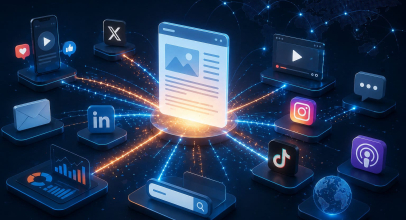
The strongest plan combines them. For example, an original study can be published on the company website, summarized in an email, adapted into several social posts, offered to journalists as a source, and promoted to a narrowly defined audience through paid advertising.
This produces multiple discovery opportunities from one central asset.
Create a distribution package for every major article
Content distribution becomes difficult when promotion is planned only after the article is finished. By that point, the team may have no supporting visuals, quotes, examples, short-form explanations, or channel-specific messages.
A better approach is to create a distribution package during production.
For a major article, the package might contain:
-
Three social posts with different angles;
-
One email introduction;
-
Several short quotations or statistics;
-
A visual summary or infographic;
-
A short video script;
-
A carousel or slide presentation;
-
Suggested internal links;
-
Outreach messages for relevant partners;
-
Paid advertising variations;
-
A follow-up article or FAQ idea.
These assets should not repeat the same introduction word for word. Each one should present a distinct reason to engage with the central resource.
One social post might focus on a common mistake. Another could share a practical framework. A third might challenge a widely accepted assumption. The email can provide context for existing subscribers, while a video demonstrates one part of the process.
The original article remains the most complete version, but each derivative asset should still offer independent value. Audiences quickly recognize posts that provide no information and merely demand a click.
Adapt the message instead of copying it everywhere
Cross-platform distribution does not mean publishing identical content on every network.
Each platform has different user expectations. LinkedIn users may respond to professional insights, personal experience, and business implications. Instagram often requires a stronger visual concept. YouTube supports demonstrations and deeper explanations. Email allows direct communication with people who have already expressed interest.
The core idea can remain consistent while the opening, format, length, and call to action change.
Consider an article about reducing customer acquisition costs. The same topic could become:
-
A LinkedIn post explaining one strategic mistake;
-
A short video showing how acquisition cost is calculated;
-
An email with a practical diagnostic checklist;
-
A visual comparison of acquisition channels;
-
A podcast discussion about measurement errors;
-
A webinar covering the complete optimization process.
This is not artificial duplication. It is message adaptation.
The most important information should not always be hidden behind a link. Providing a useful idea directly within the platform can earn trust and increase the likelihood that users will remember the brand. The website visit should offer deeper analysis, evidence, tools, or a logical next step rather than simply repeating the post.
Treat internal linking as a distribution channel
Internal links are often discussed as a technical SEO element, but they also serve a marketing function. They guide existing visitors toward related information and help turn individual articles into a connected customer journey.
A new article should receive links from older pages that already attract relevant traffic. This creates an immediate discovery path without waiting for search rankings or social engagement.
The link should appear where it helps the reader continue the subject. A generic list of “related posts” can be useful, but a contextual link within the body usually communicates the relationship more clearly.
Content hubs can strengthen this structure. A broad central guide introduces the subject and links to specialized resources. Those supporting pages link back to the hub and to one another when relevant.
For example, a content marketing hub might connect articles about:
-
Editorial planning;
-
Audience research;
-
Search visibility;
-
Content distribution;
-
Email promotion;
-
Conversion measurement;
-
Updating old articles.
This structure helps readers explore the topic without returning to search after every question. It also demonstrates that the website covers the subject systematically rather than through unrelated posts.
Google recommends using descriptive, crawlable links so that both users and search engines can understand the destination.
Make email a central part of distribution
Email remains one of the most controllable ways to distribute content. The company does not have to wait for a social algorithm to show the message, and subscribers have already provided permission for direct communication.
However, an email newsletter should not become an automated list of recent links. Subscribers need a reason to open it.
A strong content email can explain why the topic matters, identify the problem it solves, and provide one useful insight before introducing the full resource. The message should feel complete enough to be valuable but focused enough to encourage further reading.
Segmentation improves relevance. Customers, prospects, partners, and general subscribers may not need the same article or the same introduction. A technical guide can be presented differently to specialists and business owners.
Email can also extend the life of older content. A useful article does not become irrelevant merely because it was published several months earlier. It can be included in onboarding sequences, customer education, seasonal campaigns, and topic-specific newsletters.
The objective is not to send every article to the entire database. It is to match each resource with the subscribers most likely to benefit from it.
Earn distribution through original value
Earned distribution is difficult to control because another person must decide that the content is worth mentioning. Generic articles rarely provide a strong reason for journalists, bloggers, experts, or industry organizations to reference them.
Original value makes outreach more effective. This can include:
-
Proprietary data;
-
A transparent experiment;
-
A detailed case study;
-
An expert forecast;
-
A useful visual framework;
-
A specialized calculator;
-
A documented process;
-
A well-supported position on an industry issue.
Google’s people-first content guidance encourages publishers to provide original information, research, analysis, reporting, and substantial value rather than simply summarizing what other sources already say.
This principle also applies to marketing distribution. People share and cite resources that help them explain something, support an argument, solve a problem, or provide evidence.
Outreach should identify a specific reason the resource is relevant to the recipient. A mass message asking for a backlink is easy to ignore. A concise note explaining how original data supports an article they are preparing is more credible.
Earned visibility can continue long after a social campaign ends. A useful resource may attract references, referral traffic, and brand mentions for months or years.
Use paid promotion selectively
Paid distribution can provide immediate reach, but it should not be used to compensate for weak content or unclear targeting.
Before spending money, verify that the article supports a commercial objective. A broad educational page may be valuable for awareness but unsuitable for a direct lead-generation campaign. A comparison guide, calculator, webinar, or case study may provide a clearer path toward conversion.
Small tests are preferable to large initial budgets. Marketers can compare headlines, audience segments, creative formats, and calls to action before expanding the campaign.
Paid promotion is particularly useful when:
-
The company has limited organic reach;
-
The content supports an important product launch;
-
A high-value audience can be targeted accurately;
-
The article has already produced positive organic engagement;
-
Retargeting can reconnect with previous website visitors;
-
The company needs fast feedback on positioning.
Campaign evaluation should extend beyond clicks. A low-cost click has little value when visitors leave immediately or have no connection to the intended market.
Consider engaged visits, email subscriptions, qualified inquiries, assisted conversions, and subsequent branded searches. Paid distribution should contribute to a measurable marketing journey rather than merely increasing traffic.
Prepare content for AI-supported discovery
Content distribution in 2026 also includes AI-supported search experiences. Users can receive summaries, comparisons, and recommendations before deciding whether to visit a source website.
Google states that the same foundational SEO practices used for standard Search also apply to AI Overviews and AI Mode. Pages still need to be accessible, technically eligible, and focused on helpful, reliable, people-first information.
This means companies should not treat AI visibility as a separate shortcut. A page that is inaccessible, repetitive, vague, or unsupported is unlikely to become more valuable merely because it contains additional headings or artificially formatted questions.
Content intended for broad discovery should communicate its main ideas clearly. Definitions, comparisons, steps, limitations, evidence, and conclusions should be understandable without relying on vague promotional language.
Original expertise is especially important. Google’s current generative AI guidance recommends developing expert-led, non-commodity material that provides value beyond information already repeated across the web.
Brands should also maintain consistent information across their website, social profiles, professional directories, videos, reviews, and third-party coverage. Discovery increasingly occurs across multiple surfaces, so unclear or contradictory brand information can weaken trust.
Build a realistic distribution timeline
One social post on publication day is not a distribution strategy. Valuable content should be promoted repeatedly, but each repetition should have a reason.
A practical timeline can look like this:
Publication day
Publish the article, verify its technical accessibility, add internal links, include it in the sitemap, send the primary email, and share the first social message.
First week
Publish additional social angles, contact relevant partners or experts, answer audience questions, and test one short-form visual or video.
First month
Include the article in another newsletter segment, reference it in related content, evaluate initial search impressions, and consider limited paid amplification.
Following quarter
Update the article when necessary, repurpose its strongest section, add new internal links, review conversions, and identify whether a supporting article should be created.
This schedule prevents the content from disappearing after its first day while avoiding repetitive promotion.
Evergreen resources can be redistributed when the topic becomes relevant again. Seasonal articles should be updated and promoted before demand peaks, not after the audience has already completed its research.
Measure the entire distribution funnel
Traffic is useful, but it should not be the only measure of success.
A distribution campaign can create awareness without producing immediate visits. A customer may see a social post, encounter the company again in search, subscribe later, and finally contact the business through a direct visit.
Measurement should therefore include several levels.
| Funnel level | Useful metrics |
|---|---|
| Technical availability | Indexing status, crawlability, valid sitemap inclusion |
| Discovery | Search impressions, social reach, video views, email delivery |
| Attention | Click-through rate, email opens, video retention |
| Engagement | Reading time, scroll depth, saves, shares, replies |
| Relationship | Subscribers, returning visitors, branded searches |
| Conversion | Inquiries, registrations, purchases, qualified leads |
| Business impact | Revenue, customer acquisition cost, assisted conversions |
No single metric proves that content is successful. High reach with no meaningful engagement may indicate poor audience targeting. Strong engagement with no next step may reveal a conversion problem. Leads that never become customers may indicate that the content attracts the wrong market.
Marketers should define the primary objective before publishing. An awareness article should not be judged by the same standard as a product comparison page. Each asset needs an appropriate role within the larger strategy.
Common content distribution mistakes
The most common mistake is beginning distribution after publication. This produces rushed social posts, missing visuals, weak outreach, and no agreement about the intended audience.
Another mistake is using the same promotional message repeatedly. Audiences need different entry points into the subject, not identical reminders that a new article exists.
Businesses also distribute too broadly. Reaching a large general audience can produce impressive impression counts while generating little commercial value. A smaller group of relevant readers may deliver better results.
Other frequent problems include:
-
Promoting a page before checking its indexability;
-
Depending entirely on one social network;
-
Ignoring existing email subscribers;
-
Failing to add internal links from successful older pages;
-
Publishing generic content that nobody has a reason to cite;
-
Using paid traffic without a conversion path;
-
Evaluating every article only by direct sales;
-
Abandoning evergreen content after its first campaign;
-
Creating more content instead of improving distribution for existing assets.
The solution is not necessarily to publish more frequently. Many businesses already possess useful articles that have never received systematic promotion.
An audit of existing content can identify resources that should be updated, consolidated, repurposed, or redistributed before another editorial schedule is expanded.
A practical 90-day content distribution plan
During the first 30 days, audit the existing content library. Identify which pages are indexed, which attract impressions, which generate engagement, and which support products or services.
Select a small group of high-potential resources rather than attempting to promote the entire archive. Improve outdated information, titles, introductions, internal links, visuals, and calls to action.
During days 31 to 60, build distribution packages for those resources. Prepare email messages, social variations, video scripts, partner outreach, and any necessary paid campaign creative.
Match every article with a defined audience and business objective. Establish baseline measurements so later changes can be evaluated accurately.
During days 61 to 90, distribute the content according to a planned schedule. Monitor discovery, engagement, subscriber growth, qualified traffic, and conversions.
At the end of the period, compare performance by topic, channel, format, and audience. The goal is not merely to identify the article with the most views. Determine which combinations produce meaningful progress toward a business objective.
The findings should influence future production. When a particular topic consistently generates relevant engagement and qualified leads, the company can develop a stronger content cluster around it.
Make distribution part of content creation
Content marketing becomes inefficient when production and distribution operate as separate activities. Writers create articles without knowing how they will be promoted, while marketers receive finished pages without the supporting assets needed for an effective campaign.
Distribution should be considered during topic selection, research, writing, design, and publication.
Before approving an article, the team should be able to explain who will read it, how they will discover it, what makes it worth sharing, and where it leads next.
This approach may result in fewer published articles, but each resource receives more attention and has a clearer opportunity to produce results.
A strong article does not generate traffic simply because it exists. It succeeds when the page is technically discoverable, connected to a real customer need, adapted for relevant channels, distributed repeatedly, and integrated into a measurable path toward conversion.
The Publish button is not the end of content marketing. It is the moment when content marketing actually begins.